


Hospitals
Imaging support and ward signals that give specialists time for the cases that need them.
- Urgent studies surface ahead of routine reads
- Ward flags before the morning round
- Results sit in the chart, not a second system
Hospitals, pharma, research, and healthtech.
Platforms for diagnostics, drug discovery, and patient care. They sit inside the clinical systems you already run. A clinician or scientist stays the decision.
Illustrative list. A specialist confirms every result. Nothing here is a diagnosis.
Encryption and access control are part of the release, from an ISO 27001 certified team.
The platform is designed for these rules. Patient data stays under your control.
Results land in the worklist and the chart people already open.
Custom models are built for your organization to own.
Who it is for
Hospitals, pharmaceutical companies, research institutions, and healthtech teams. The platform has to live in a reading room, a lab, a trial, or a care program.
Imaging support and ward signals that give specialists time for the cases that need them.
Molecule screening, targets, toxicity flags, and help around the trial record.
Literature, multi-omics, and study files in one place a scientist can check.
A private model and a product surface, with the privacy design buyers will ask about.
What the platform covers
None of these replace the clinician or scientist who signs the result. Filter by area, and see what goes in, what comes out, and who decides.
Try it · imaging
Move the confidence threshold to see how studies are ordered. Low-confidence results are not hidden or decided by software. They wait in a review queue for a person.
Illustrative image. Not a diagnosis. A specialist confirms every finding.
Core capabilities
Choose a capability. The worklist in the hero follows the same choice.
Try it · discovery
Screening narrows the field and ranks what is left, each with evidence a scientist can open and challenge. Counts shown are illustrative.
The care journey
Follow one patient through the system. Select a stage to see what the platform does, which system it touches, and who decides.
Try it · patient care
Move the signals and watch how a deterioration flag is routed. This mirrors how a model would be tuned to a care plan.
Illustrative routing logic · your model is tuned to the care plan and data you provide
Where it lands
Pick a setting to see what changes, the first build we would scope, and how success is measured.
Integration
Results are written in the shape those systems already accept, so there is no second chart. Select a connection to see what flows. Standards shown are typical and confirmed per site.
Privacy by design
Access control, encryption, audit trails, and federated learning when the data should not move.
Validation and safety
A demo is not validation. Readers and researchers check the work against the success measure from the workflow, and a person stays in the loop at every step.
The model proposes a finding, a rank or a flag, with its confidence and its source.
A specialist or scientist opens the evidence. Low-confidence items wait in a queue.
A named person signs. The platform never signs the chart.
The decision and the access are logged for audit and for model monitoring.
How many real findings the model catches, checked against your readers.
How often a normal case is wrongly flagged, so the queue stays worth reading.
Study-to-first-read time before and after, in your own workflow.
How often a clinician disagrees. A rising rate is a reason to look again.
Monitoring for changes in scanners, protocols or population after go-live.
Every access and every decision traceable for the privacy office.
How we deliver
We start from the workflow and the data you can actually use.
What you get
Imaging support can help surface urgent studies sooner and free specialists for critical cases.
Screening and trial support so teams spend less time chasing weak candidates.
Follow-up signals and remote check-ins, with patient data protected while the platform runs.
Estimate
A rough estimate to start the conversation. Set the time saved from your own validation, not from ours.
In every engagement
Who uses it, what they decide, and what the software must not decide.
If the data cannot be used, the build does not start.
Model, screen, and where the result appears in the workday.
The chart and the worklist stay the system of record.
Readers or researchers check it before anyone relies on it.
The platform does not sign the chart.
HIPAA, PHIPA, and GDPR, with audit and federated learning when data should not move.
You keep the models and the application, with notes for your team.
Case study
A leading healthcare network performing over 6,000 annual inpatient and ambulatory surgical procedures faced rising 30-day readmissions and heavy administrative burdens during post-discharge follow-up. Clinical care coordinators relied on manual phone calls to check on recovering patients, leaving care teams blind to early surgical site infections, pain spikes, or medication side effects between scheduled appointments. With patient recovery notes fragmented across disparate spreadsheets and voicemail logs, nurses spent over 15 hours weekly tracking down updates rather than treating acute patient needs. The organization required a secure, HIPAA-compliant digital platform to track recovery metrics remotely and alert clinicians to early warning signs before minor issues escalated into emergency room visits.
Acesoft engineered a secure, cloud-based Post Op Monitor platform and mobile check-in portal designed around procedure-specific recovery pathways. Discharged patients receive scheduled, automated notifications to complete brief symptom surveys, log vital signs, and submit secure photos of surgical wound healing. The platform’s analytics engine evaluates incoming responses against defined clinical protocols, instantly flagging abnormal pain indicators, elevated temperatures, or erratic vital trends on a centralized triage dashboard. An integrated clinical assistant summarizes submitted patient logs and pre-populates follow-up notes directly into the hospital's central electronic health record via secure APIs. Strict role-based permissions ensure patient health data remains encrypted and accessible only to authorized surgical and nursing teams, while automated alerts keep all clinical diagnostic and treatment decisions firmly in the hands of attending physicians.
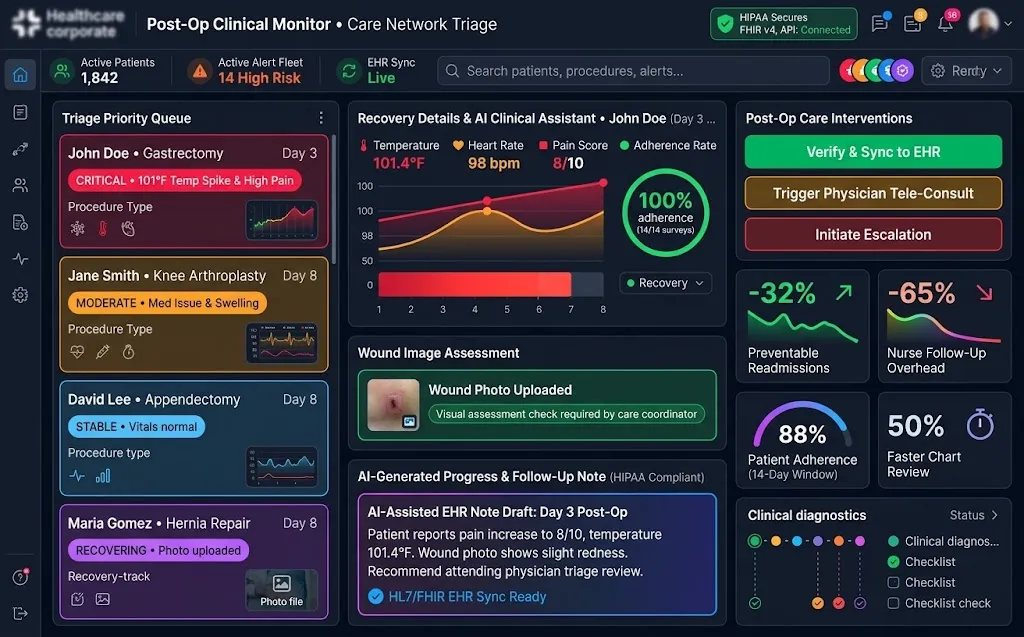
Early detection of post-surgical complications enabled timely outpatient interventions before emergency hospitalization was needed.
Automated digital check-ins replaced manual outbound calling queues, allowing nurses to prioritize high-risk patients.
Intuitive, mobile-first survey prompts ensured consistent reporting across the critical 14-day post-op window.
AI-assisted recovery summaries unified longitudinal symptom trends into a single-screen view.
End-to-end encryption and direct EHR synchronization eliminated dual-entry data errors across hospital systems.
Talk to our teamBy connecting recovering surgical patients with clinical care teams through automated monitoring and intelligent triage dashboards, the healthcare network reduced readmission penalties and improved recovery visibility. The project highlights how Acesoft’s custom healthcare software and AI engineering streamline clinical follow-up workflows, safeguard patient data, and deliver scalable remote care without increasing hospital staffing overhead.
FAQ
A solution architect will walk through the workflow with you.
Book a free consultationHospitals, pharmaceutical companies, research institutions, and healthtech teams.
No. It supports the person who is accountable. Low-confidence results wait, and a specialist still decides.
Yes. Imaging and care workflows are designed for PACS, EMR, and EHR.
You do. Custom models are built for you to own. Data stays in your environment when that is the rule.
HIPAA, PHIPA, and GDPR, depending on where the data and the users are. Acesoft is also ISO 27001 certified.
HealthApp and PostOp Monitor cover care-team and recovery use. This page is the platform behind clinical and research operations.
Low-confidence results are held in a review queue for a specialist instead of being decided by software. You set the threshold with your own readers during validation.
Readers or researchers check results against the success measure from the workflow, in short cycles. We track measures such as sensitivity, false alarms, time to read, and override rate.
Yes. We design for where the data lives. When sets should not move, federated learning lets the model learn without the records leaving the site.
Whether a tool needs clearance depends on its intended use and where it is deployed. We design validation and documentation that your regulatory team can build on, and they decide the pathway.
Related AI services and the care products already on this site.
Let's talk
Tell us what you are working on. A solution architect will reply with a free consultation, usually within one business day.
 Got an idea? Let's talk